Marrakech
- Delaney Hanon
- Nov 25, 2025
- 17 min read

November 19-24
Toto, we're not in Europe anymore.

As we flew into "the red city," Calvin looked out the window and proclaimed, "I've never seen anything like this before." The uniformly terracotta color of the buildings, the flat, open roofs meant for sitting and taking a meal, the constant rev of motorbikes...everything about this city is new and unfamiliar the second we emerged from the airport. This is by far the furthest we have been outside our comfort zone, and we have to admit that has been a struggle for us.
Really, our time in Marrakech started out on a sour note, which really colored the first several days of our stay here. Mom--you might want to skip ahead past this next part, as I know it is going to freak you out. When you reach the picture of the cat on the motorcycle, you can jump back in.

We got a taxi from the airport to our Riad (think of this as a Moroccan B&B), but were informed when we met the driver that he wouldn't be able to take us all the way to the front door, because this part of the Medina is not accessible by car. He asked if we had internet (to access the map), and assured us that it was only an 8 minute walk or so from where he would drop us off. This was not completely unexpected, as I knew parts of the Medina were too narrow for cars, so we agreed and were on our way. He dropped us at the edge of a narrow Souk (marketplace), pointed us in the right direction, and told us if we needed anything else during our stay we could contact him.
We started walking, phone gripped firmly in hand, our backs laden with heavy packs, through the narrow alleys. While skirting past shopkeepers desperate for our attention, motorcycles zipping inches away, and mule-pulled carts plodding alongside us, we got a bit turned around a couple of times. Understandably, Google Maps is not quite accurate to each and every serpentine streets in this ancient part of the city. We doubled back at one point, and this is where I did something stupid and got us into our pickle. As we were studying the map, trying to get oriented, someone asked us in English where we were trying to go. I responded with the name of our Riad, and he told us to follow his friend who was heading that way. We took off in the direction, but then realized we were not going the right way. Stopping again, both friends took a look at the address on my phone, realized where we needed to go, and led us again. We approached the pin on the map where Google said our Riad should be, and instead found the entrance to a narrow, covered alley that led off a square. As we entered, the first guy pointed out the sign at the top of the alley with the name of our hotel, indicating that we were indeed going in the right direction and also mentioning this was truly an authentic Moroccan experience. As we were led deeper and deeper into this alley, my sense of dread increased, and I realized how stupid it was to be following two random guys into this dark, empty alley. However, as we went deeper and deeper, there were still scattered signs with arrows indicating that the Riad was indeed this way. (The video below was taken by Calvin after this incident, so you can get an idea of how deep we had to go, and probably why my spidey senses were tingling.)
We reached a doorway that had the name of our Riad posted next to the big entrance, and thanked the guys for helping us. This is where it went south. We offered them 50 dirham (about $5, and the amount our guide the following day confirmed was correct for this type of service) for helping us, and the faux-friendliness with which they had been treating us quickly disappeared. We told them it was all we had, which was of course not true, but there was no way we were showing these two where the rest was kept. They, of course, closed in on us repeating that it was not enough for the work of both of them. At this point, unknown to me, a good cop bad cop situation was being performed, wherein the man on Calvin's side was mad-dogging and even punched him in the arm, while the other on my side tried to "calm him down" and repeated that we needed to pay more. This is where I think I redeem myself--I loudly said "We have to go!" and pushed through them to the door of our Riad, and kept repeating it loudly to hopefully draw the attention of someone nearby. Thankfully, the two "helpers" returned down the alley, and our host Abdul opened the door immediately and greeted us with traditional Moroccan mint tea.
This type of thing is common in Marrakech--I had read about a similar incident happening to another traveler on Reddit a couple of days preciously--but the fact that it happened almost immediately after arriving in the city, and in an area where we felt completely isolated from anyone else, really scared us. We were quite frankly traumatized, and the next 24 hours were spent in a constant "fight or flight" state of adrenaline, and had a hard time trusting anyone's true intentions throughout the first few days of our visit. Thankfully, this is the worst of anything we experienced in Morocco, and from here on out things improved.

Day 1: A Tour with Youssef
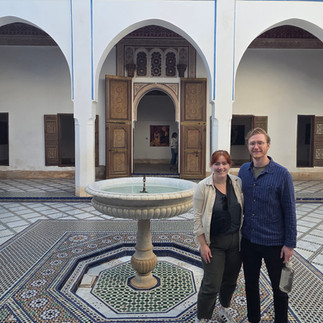
Abdul, the night host at our Riad, set us up with a tour guide for our first full day in Marrakech. Since we were still feeling a bit unsure after the incident the night before, it was reassuring to know we would have someone showing us around. Youssef met us at our Riad at 9 am and led us back down the narrow alley, back through the Souks, and back to the square where we had been dropped the previous day. From here, we took a cab (about $3) to the Old Jewish Quarter, where we started by exploring the Bahia Palace. This is a newer palace for Marrakech, having been built in the 19th century for the favorite of the Grand Vizir's wives. Youssef led us through mosaic covered rooms and explained the significance of having four sections to the courtyard's garden, which is separated in this way to symbolize the four rivers that await Muslims in the garden of heaven. When we arrived, the palace was quiet and had very few visitors, but as we explored more and more groups began to join us, just as Youssef had predicted.



From the palace, we walked a short jaunt to what used to be the Jewish salt market. Nowadays, all are welcome, but you have to be prepared for a different style of shopping. Full carcasses hung from hooks, rows of butchers sans-apron hacking away at them in the same corridors we walked. Calvin got a good splash of chicken juice to the face while walking past the fowl butchers, still-clucking chickens patiently waiting a few steps away (which, if you know me well, unsettled me more than the dead ones). A team of fishmongers glanced up while sliding fingers through the guts of fish and plopping the contents to the ground. In between stalls for goat, chicken, and fish were dozens of small stoves, each with two or three young boys boasting fists full of dough busy making the day's bread. We didn't buy anything.
Exiting the market, we walked to the Koutoubia mosque, currently under renovation, but which we of course could not enter either way as non-Muslims. Youssef explained that the original building from 1147 had been entirely torn down only a decade or so later by the new regime in order to correct its direction facing Mecca by about 8 degrees (he also explained that this was probably pettiness as the first regime had been Sunni, while the second was Shi'a).

Then we walked to the famous Jemaa el-Fnaa square, the main square in Marrakesh. At this point it was only about 10 am, so the square was relatively quiet. Still, we saw snake charmers, men with monkeys on chain leashes, and henna artists all poised to perform for the tourists that would descend throughout the day. Youssef helpfully explained what is expected by these performers (for example, if you take a picture you should tip between $1-5, but you don't need to tip otherwise) and what to do if they, like our "helpers" the night before, insisted you didn't pay enough (shout "police" or just walk away). As we went from sight to sight throughout the day, Youssef offered several times to take our picture, so we have several pictures of the two of us in each place, which is a bit of a departure from the selfies and alternating pics we have had so far in our travels. It turns out Youssed is quite handy with a phone, delving into camera settings and going for angles he knows offer the results tourists crave. Below, you can see a picture of Calvin and Youssef in the main square.

From the main square we ventured into the heart of the Medina, with its many winding streets of Souks. Again, it was incredibly helpful to have Youssef, firstly because he leads tours such as this every day and knows the streets--he laughed when I asked him if he ever got lost. Secondly, Youssef took us to many of the traditional market stalls that visitors to Marrakech want to see--Argan oil, carpets, leather goods, etc.--but we felt we were going to reputable places and didn't feel pressured to buy anything. In the end, we purchased some orange blossom argan oil and some new soap, but mostly just marveled at the work surrounding us. Calvin desperately wanted to buy a carpet, but as we don't yet know where we will be living when we return, I advised against it.


Our final stop of the tour was the Medersa Ben Youssef, a Quaranic school nearby our Riad (which is called "Riad la Medersa" due to its proximity). This school is adjacent to the Ben Youssef mosque, which was built in the 12th century, and is a popular site for those who wish to see how schools such as this would function. About 600 students could study and live here at a time, staying 4-5 to a room. We explored these rooms, which were difficult to navigate with just the two of us standing up, and the various courtyards and hallways of the beautiful school.


From here, Youssef led us back to our Riad, where we rested for a few hours before heading back out to dinner. At this point, we are officially in the "skipping meals to save money" phase of our trip, as Marrakech is surprisingly expensive in some regards. Some things are really cheap, such as fresh fruit, juice, or cab rides, but in the heart of the city a meal can cost as much as it did in many places in Europe. Thankfully, we found a couple of places very near our Riad where we could eat affordably with a view--many of the restaurants in Marrakech feature rooftop terraces for dining, which is the perfect way to end a day of exploring if you're willing to risk the lack of a safety rating.

Day 2: Le Jardin Marjorelle
Our second full day in Marrakech was more laid back. We started the day with breakfast our our Riad, which is a truly lovely experience. We sit up on the roof, enjoying the first of the day's sun, while Abdul brings up 2 full trays of goodies for us. Coffee and warm milk, fresh mint tea, freshly squeezed orange juice, at least 2 kinds of bread, both green and black olives, and eggs, with a variety of spices, jams, and honey to adorn our plates. We had left quickly for our tour with Youssef the previous day, so this morning we had the luxury of lingering on the roof and spending some time planning our next moves after Morocco.

In the afternoon, we walked across town to Le Jardin Marjorelle. Although fortified from our tour with Youssef, we were still overwhelmed by the streets of the Medina. Even in crowded market streets, motorcycles push their way through just inches from your feet. Street cats munch on discarded food or nap in the carpets. Eager shop keepers shout incessantly at passing tourists, trying multiple languages to get one to turn around and potentially enter their domain. Each street turns and twists into the next, and it is difficult to tell at which shop selling the same teapots and the same shoes you need to remember to turn right. After exiting the medina, we tackled the next obstacle, which required an equal amount of girding of loins: crossing the large motorways that flank the old town. We had some experience of this type of driving while in Rome, but not nearly to this degree. At the end of the day, you just have to point your nose upstream of the motorcycles and scooters, and pray that their drivers don't want to get in a collision just as much as you don't.
After a good long walk, we started to see much more modern builds, signaling we were well and truly outside of the medina, and in the vicinity of Le Jardin Marjorelle. The house and garden were originally constructed in the early 20th century by French painter Jacques Marjorelle, and then purchased by Yves Saint Laurent and Pierre Bergé. The site is now open to the public, and also houses a duo of museams--the Yves Saint Laurent museum and a Museum of Berber arts, the latter of which we visited. This garden is famous for the striking blue color of the house to which it belongs, which comes from the same cobalt used in many of the mosaics around the city. The layout is inspired by Islamic gardens, completely walled in and serving as an oasis from the noise and business of the rest of Marrakech, and quartered in a similar style to the Bahia Palace. Paths lead the way among exotic plants collected from all over the world, and beautiful fountains feature at every turn. Led not only by paths and fountains, we were also amused to find a separate worker stationed at every corner, bend, and twist, mutely gesturing toward the direction visitors were already headed.





The Museum of Berber Arts is small but fascinating. The collection features tools and cookware, famously ornate jewelry, and clothing from the various Berber peoples from around Morocco. The Berber are the original inhabitants of the area, before the Arabs came bringing Islam to the region. Most modern Moroccans are both Arab and Berber, and the influence of the peoples can be seen in all aspects of Moroccan culture. No pictures can be taken inside the museum, so we can't share what we saw here, but we were very happy to have been able to explore it ourselves. Needless to say, the metal-working and weaving displayed in the museum was incredible, and reminded both of us of certain decorative themes from Pacific Northwest Indian crafts and art.

Day 3: Day Trip to the Atlas Mountains
By far our best day in Morocco was Saturday, when we had a guided day trip to the Atlas Mountains. For just $35 total, we had the whole day--including meals--planned and organized for us. Our guide for the day, Fuzia, picked us up at Jemaa el-Fnaa square around 8:30. When we had practiced the walk from our Riad the day before, it took us over 30 minutes to squeeze our way through the crowded Souks to the meeting spot. However, it was deserted early in the morning, as the shops were just opening up and the tourists had not yet made their way into the markets, and only took us about 12 minutes to make the journey. Since we arrived early, we got coffee and mint tea at a cafe on the edge of the square as we waited.

When Fuzia arrived, she led us to the small bus that was already filled with our comrades for the day. In total, there were about 15 or so of us, and Cal and I were the only Americans. There was a group of 6 Dutch women, on a work trip together, a couple from Athens, a couple from Romania, and a mother and son (about 8 years old) from France.
Our first stop of the day was riding camels in traditional Berber clothing. Technically, these were not camels, they were dromedaries, as they only have one hump, not two, but to make things easy we are just going to call them camels. Calvin decided he was too cool to wear the traditional clothing handed out to us, but when I saw that they had my signature color (yellow), I had to join in. While it is hard to tell from the photos, we were really just off the main road out of Marrakech, and this was clearly a common stop for other tours because they had a constant stream of small busses, just like ours, coming into the lot. Still, it was quite the experience. When my camel stood, I legitimately thought I might topple right off! These animals are enormous, and stood a good ten feet into the air, so the fall would not have been a pleasant one. We road in a long chain, and as we road the handlers graciously and expertly took pictures and videos for us. The "mirage" you see was created by one of them holding up their phone underneath ours! When they took the videos, they played music from their own phones to create the effect. Definitely pros.


After riding the camels, we sat nearby and drank mint tea while Fuzia explained how camels have been used in the area for centuries by the various peoples in Morocco. She also explained a bit about Berber language and culture, as our next stop was a traditionally built Berber house where we would get to see how women produce argan oil. We stopped briefly on the way to see a historic Berber village from afar, which is build directly into the hillside near a source of water. The landscape was a stark contrast to dusty Marrakech. As we wound our way into the first of many valleys, forests of olive and argan trees started to speckle the now dry streams cutting though mountains.

When we arrived at the next stop, we were again shown past other tour groups into a house built from mud, hay, and bamboo. Although these materials sound temporary, this house had stood for 120 years! We sat in a dark room on cushions skirting small tables and were brought tea, bread, and various dips--olive oil, agave honey, and peanut butter mixed with a small amount of honey (my personal favorite). After we ate, we were shown to another room where 3 older women were sitting and preparing argan oil. To do this, one has to shell the seeds from the argan tree, which only grows in Morocco. From there, the seeds are either roasted to be prepared for cooking or left raw to be prepared for cosmetics. The women also took a pause while we were there to play some music for us. It was all definitely a show for the tourists, but it was really cool to see a women's co-op whose purpose is to continue a craft traditionally done by women for generations.

Once we had the opportunity to purchase some of the wares made by the women of the co-op, we piled back on the bus to the next stop--a Berber market. This was a "bonus" stop, as the market is open only on Saturdays. When we arrived, Fuzia told us to stay close and watch our things, as the market was going to be crowded, and if we got lost she might not be able to find us again. Once we made our way into the market, I realized she had drastically undersold the chaos of the whole affair. I wasn't really able to get pictures inside, because it was so crowded and we were moving so quickly I didn't want to get left behind! The layout of the market is in stark contrast to that of the Marrakech medina. Whereas Marakech is a series of streets, corridors, and tunnels constructed from the buildings shopkeepers inhabit, the market we stopped at in the mountains was a vast sprawling courtyard. That is not to say there wasn't structure to it, however. Covering the entire area were hundreds of plastic woven tarps hanging just below head level, forcing one to stoop down and follow the strong currents of hustling and bustling shoppers. Just like the market we had visited with Youssef, this one featured a butcher section, complete with tables sporting dozens and dozens of goat heads, detached from the bodies that hung nearby. Again, live chickens buzzed around while their comrades were carved up. Turning the corner, there were rows upon rows of produce stands, featuring potatoes, carrots, lettuce, apples, and all sorts of things I would regularly find at the West Seattle farmer's market this time of year. There were also tables selling tools, a couple of "healers" who offered massages with hot rags, and various items of clothing, legitimate and otherwise. Every row of the market was packed with people, and even though our group stood out, it was hard to stay together as various shoppers wove in and out of our line. Fully overwhelmed by it all, we made it back to the bus in one piece and headed to our next stop: lunch.
We wound our way further still into the mountains, peering out the windows at the death-defying roads suspended above the valley floor. Finally, the bus came to a rest at a small town littered with mountaineering outfitters. Racks of hiking poles, ice axes, helmets, and down jackets decorated dozens of stalls, all loomed over by enourmous mountains dusted only by the faintest breath of snow. We wove our way through these streets, past mosques, and up concrete steps poured directly into the gravel hillside. Finally, we arrived at a house and restaurant built into the mountain, with all the stunning views a location like that affords. The hike up was a doozy, but luckily for me there were also 2 cats here who joined us for lunch. I could actually pet these little guys because they aren't "street cats" who have "diseases" according to Calvin. Fuzia and her family brought out chicken tagine, tabouleh salad, couscous, and fresh bread. Everything was delicious, and finished off with a yogurt apple tart/pie dessert which left me pining for the pie I won't get to have this week at Thanksgiving.


After lunch, we continued climbing the stairs behind Fuzia's home even further up into the hillside and followed a trail around the valley, ducking into and out of the shadows of the peaks around us. As we walked, we got to know some of the other people in our group and share about our travels--it was crazy that we had been (or were about to be) in all the places each of the other group members came from!
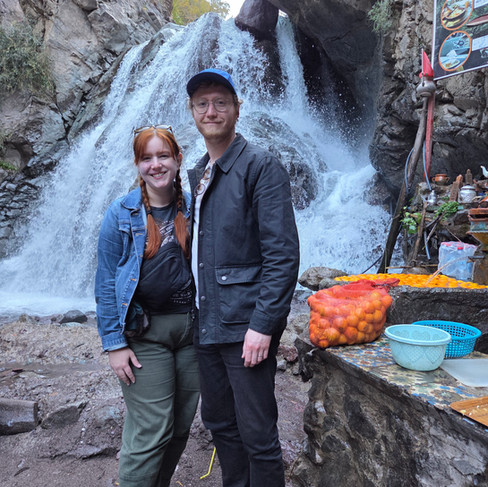
The crowning moment of the hike was a waterfall, fed by the snow of the mountains. After tiptoeing across some not-quite-trustworthy bridges, we arrived at the center of attention. Around the waterfall, people had set up a small cafe of sorts! There were tables and chairs, a guy pressing fresh orange juice from fruit kept cold in the water of the falls, and even a table full of tagines cooking atop hot coals.



From here, we walked back to the bus and made the hour or so drive back to Marrakech. We walked back through Jemaa el-Fnaa square, now busy with the evening crowds and full of even more performers--snake charmers, musicians, and henna artists, all surrounded by enraptured tourists. Our experience in the more authentic, and much more hectic market earlier in the day gave us a confidence in navigating Marrakech which we had fully lacked before. We made our way back towards our Riad, and stopped for dinner at a restaurant that we had found with good food and even better prices. We watched the moonrise over Marrakech and talked about our adventures of the day.

Day 4: Le Jardin Secret
Our final day in Marrakech was fairly lowkey. We started our morning with breakfast at the Riad, then set out through the streets to "The Secret Garden" which was just a few minutes away. Like Le Jardin Marjorelle, this garden began as a private residence but has since been opened to the public. This garden is much smaller, but is just as idyllic, and the fact that it lies only a few minutes away from where we were staying was such a surprise. Walking just a few feet inside to garden walls completely shuts out the noise, fumes, and chaos of the souks and allows you to bask in a green oasis. We wandered around the garden, took pictures, and just sat and enjoyed the cool breeze as we did some people watching.


Once we had our fill, we set back out into the marketplace. Cal had an inclination that he was going to try to buy some shoes, but he couldn't find a place with a product he felt very good about, and frankly didn't want to deal with the customary haggling process. Instead, we found ourselves another rooftop cafe, had some tea and a snack, and absorbed the sights and sounds of the streets. That evening, we returned to our favorite rooftop spot for a final tagine, a final fresh juice for me, and a final sunset over the city.

Marrakech was outside our comfort zone, and unfortunately we never really recovered after our tense encounter on the first night. While we certainly got more comfortable as the days wore on, we never really settled into ourselves or found our groove. A combination of sketchy streets and aggressive shopkeepers made us realize that the area we were in was designed for extracting money from foreigners in any way possible, so it was difficult to explore without travelling much further away. In the end, that's what we decided to do. In fact, we left a day early--we had planned to stay at our Riad until Tuesday, and had even toyed with traveling beyond to Casablanca or Rabat, but we were just ready to move on. We flew out on Monday, and I have to say I felt a sense of relief when our plane lifted from the runway. We are heading to Thailand, with a quick extended layover in Athens on the way. It was good for us to explore outside our comfort zone, and certainly Thailand is going to have its differences and challenges as well, but I can't say I truly enjoyed our time in Marrakech. I am proud of us for sticking it out as long as we did, and I know we have grown from the experience.


I'm proud of you both for making the most of the opportunity regardless!
The photos are just exactly how I pictured it - and good for you two for experiencing it! Don't blame you a bit for deciding to move on. Cal's video of the walk completely freaked me out ! Enjoy Thailand!